
Stop Apologizing for Having a Point
What a New York Times legend taught me about writing and why it matters for Canada

Welcome to the 860 Not Sorry readers who joined after our 2025 Canada Rewind. If you're here to make Canada impossible to ignore, subscribe:
Welcome to 2026.
I’m grateful you’re here.
Not Sorry's mission is to make Canada impossible to ignore. Writing is how we get there.
Today I’m sharing a persuasive writing playbook, inspired by what I learned from Glenn Kramon (longtime NYT editor) while at Stanford. Use it on every email, pitch, and note. Write so people say yes.
Every Monday I spotlight five builders from Founders North across fintech, defence, and everything in between. Each comes with one clear ask: a hire, a pilot, an intro.
Many of you have asked how to help. Here’s how:
Be the reason a founder gets a yes by Friday. If you can help with the ask, say yes. If you can’t, forward it to the person who can.
And here’s my one New Year’s ask: Send Not Sorry to five people. If five is a lot, two is fantastic.
The friend who stayed in Waterloo. The expat who still orders double-doubles. The Montrealer in New York with a Habs jersey in the closet (we all know one).
The bigger we get, the more doors we open.
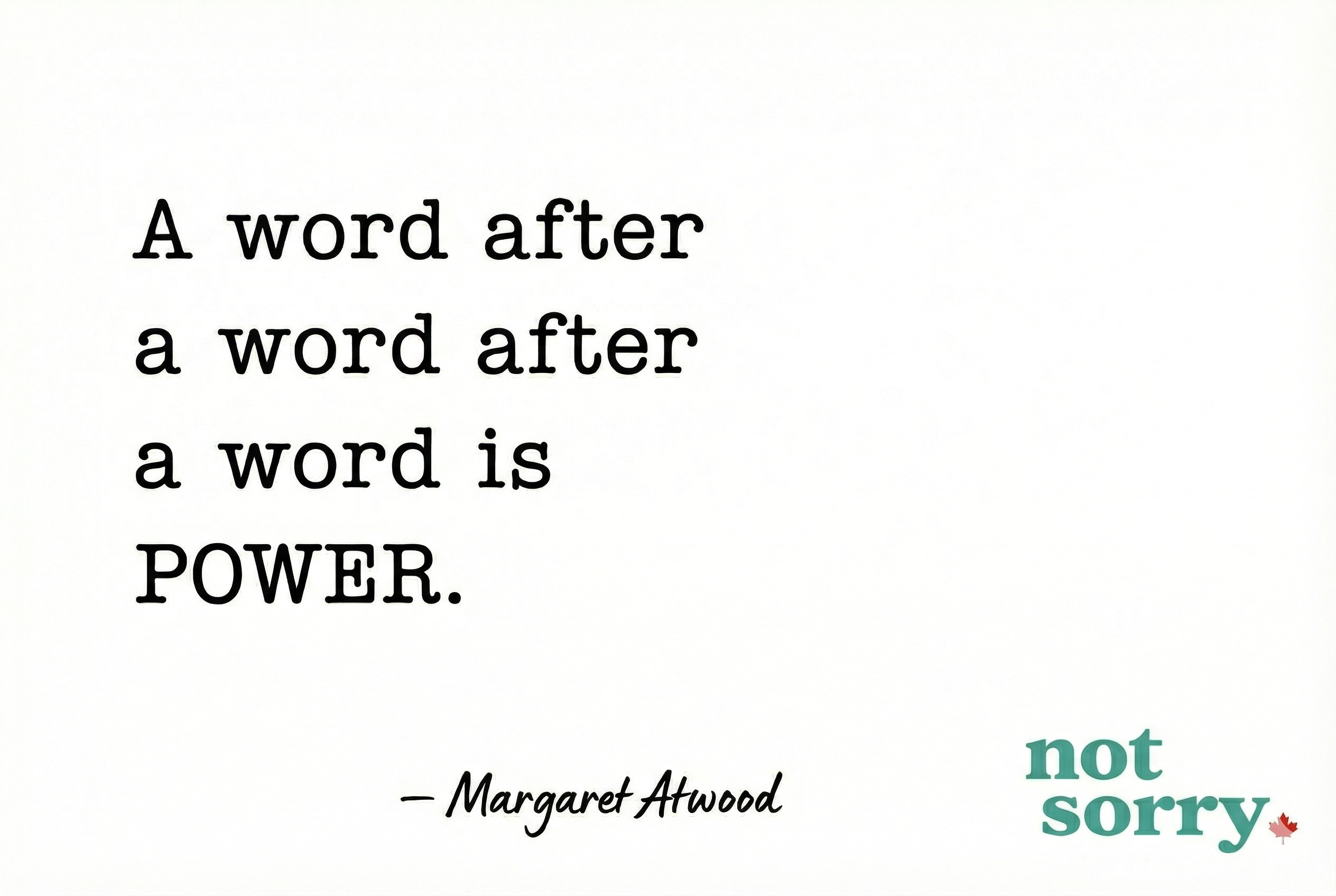
Margaret Atwood put it best: “A word after a word after a word is power.”
Let's use ours. 🇨🇦
Stop Apologizing for Having a Point
I used to write like my job depended on sounding “professional.”
From McGill to McKinsey, I leaned on the “Corporate Buffer.” I’d clear my throat for three paragraphs, hide behind words like alignment or synergy, and hope the reader would guess what I actually wanted.
It was polite. It was professional. But it failed to respect the reader’s time.
At Stanford, I studied “Winning Writing” with Glenn Kramon, a longtime New York Times editor. He gave Andrew Ross Sorkin his first shot, years before DealBook. Sorkin later wrote 1929, one of my favourite reads in 2025.
Glenn is a human lie detector for bad prose. He can hear one sentence and tell you exactly where your thinking starts to wobble.
He taught me this: don’t make people decode you. Say what you want, say why, and make the next step easy.
Inspired by Glenn, here is my playbook for clarity, so you can ask cleanly, lead warmly, and get to yes faster.
This is how we make Canada impossible to ignore.
1. The Result is the Only Metric
Before we type a single character, we have to answer the “Not Sorry” question: What result do I want?
Not “what do I want to say.” Not “what is my update.”
What do we want the reader to do when they finish?
Approve the $100M project?
Grant 15 minutes to a founder from Vancouver?
Take a shot on a product pilot?
If you don’t know the result, neither will the person you’re writing to. Hold off until you do.
2. B.L.U.F. (Bottom Line Up Front)
Glenn borrows this from the military. In a world of 3-second attention spans, you have to win—or otherwise risk losing—your audience immediately.
Stop “clearing your throat.”
The Sorry Way:
Hey! Just wanted to circle back on this. I know you're probably super busy, but I'd love to grab 15 minutes if you have time to chat about how we might be able to help with your workflow. No pressure at all—just thought it could be valuable. Let me know!
The Not Sorry Way:
You mentioned your team spends 10 hours a week on manual reporting. We automate that. Want a demo Tuesday at 2pm?
Lead with the point. If someone only reads the first two lines on their phone, they should still know exactly what you want.
3. The “Seasoning Rule” for Jargon
This rule is blunt: Enough flavour to make it work, not so much you kill the dish.
We say utilize when we mean use. We say commence when we mean start. We say streamline the process when we mean accelerate.
Say it to a friend, then write it exactly like you said it. If you wouldn’t say “I’m incentivizing my VP of Sales to implement an expansion plan” over coffee, don’t write it in a memo.
4. Cold Outreach: One in a Million vs. One of a Million
Glenn always says:
Be one in a million, not one of a million.
Canada is done being the “farm team” for global talent. When you reach out to the Nadellas, Carneys, or Andreessens of the world, don't start with "I hope you are well." Doing so reads like “one of a million” spam.
To be “one in a million,” try three things:
Start with what they don’t know: Give them an insight about their own business or a trend they haven’t seen.
Pick a lane: Don’t send a CV. Tell a story that shows us in motion.
The Small Ask: Don’t ask to “pick their brain.” Ask for a 10-minute reaction to a specific thesis.
Example:
Don’t write: “I’d love to pick your brain about AI strategy.”
Write: “You mentioned in your 2023 letter that compute is the new oil. I’m seeing a $40M gap in Canada’s inference capacity. Can I send you a 2-pager on how we’re filling it?”
Now you’ve given your busy reader a reason to care, and you’ve made it easy to say yes.
5. Feedback is Not “What’s Wrong”
This is the soul of leadership. Glenn (via Tom Friedman) says there are two kinds of critics: those who want you to fail, and those who want you to succeed. People can smell the difference a mile away.
The “Not Sorry” Feedback Loop:
Praise liberally. Say what you like, then say what you would like.
Be constructive. Don’t write “This is boring.” Write “This would be stronger if we led with the project’s ROI.”
Use the “We”: We’re building this together. “We should have invested” becomes “Should we have invested?” It’s a conversation, not a command.
6. Save Yourself (The Epilogue)
Glenn ended “Winning Writing” with a plea: Save yourself. Save yourself from becoming a shrivelled version of who you are. In business, we often trade our identity for a “corporate voice.” We become dependent on the approval of people who aren’t even in the arena.
To live large, write small.
Retain your own identity: If you're from Hamilton, say Hamilton. If you went to McGill, say McGill (not the Harvard of Canada).
Be for something: As Ken Burns told Glenn, “Do not lose your enthusiasm.”
Scatter Joy: The best writing leaves the reader feeling like they are the cleverest person in the room, not you.
The Not Sorry Writing Checklist
Words move people. If we're going to make Canada impossible to ignore, we need to write like we mean it—clear, warm, and impossible to miss.
Here’s the checklist:
BLUF: Is the point at the top?
The Cut: Can I delete 30% of this? (Usually, yes).
The Human Factor: Would I say this back home, or is this corporate jargon?
The Ask: Is it small, clear, and actionable?
Writing is a muscle. Practice it every day. I’ve kept a journal for years to keep the blade sharp, and I’m still learning.
Here's your homework: Open your last five emails that didn't get answered. Pick the most important one. Rewrite it using the checklist above. Send it again. See what happens.
Write with clarity. Lead with confidence.
Let's make Canada impossible to ignore.
Bryan
If a piece isn’t useful, tell me. It’ll help me make the next one better.
Great read Bryan and helpful for both founders and professionals climbing the corporate ladder!
Love this!